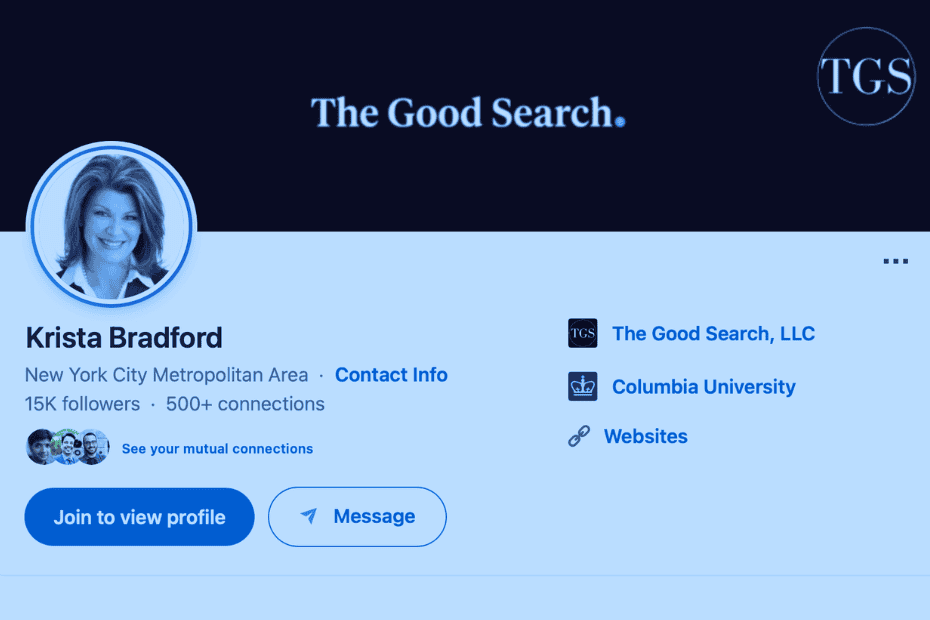
In the competitive landscape of executive search, a LinkedIn profile is rarely the reason a candidate is hired, but it is frequently the reason a candidate is eliminated. At The Good Search, we approach recruiting with the discipline of investigative research. We don’t rely on existing databases of “active” candidates; instead, we map industries to find the high-impact leaders who are often too busy driving results to focus on self-promotion.
Your LinkedIn profile is a critical source of data for executive recruiters seeking ideal candidates. If information is missing, inconsistent, or lacks evidence of impact, the research associate or headhunter moves on. Whether you are a CTO or a Chief AI Officer, here are 20 data points we use to calibrate elite talent.
I. Accessibility and Professional Signal
- A Public-Facing Profile: Privacy settings that block recruiters create friction. If a researcher cannot verify your career trajectory, they are less likely to prioritize your candidacy.
- Executive Presence (The Photo): A professional, approachable headshot remains a baseline requirement. It serves as an initial indicator of the “command” expected in a boardroom.
- Network Composition: We look for a network that reflects your industry standing. A high number of connections is less important than the presence of respected peers and industry luminaries.
- Availability for High-Value Outreach: Ensure your contact information is accessible to your 1st-degree connections. In high-stakes search, the ability to move quickly is a competitive advantage.
II. The Career Narrative: Building an Evidence-Based File
- The Professional Summary: Use this space to articulate your Leadership Thesis. What specific organizational challenges are you best equipped to solve?
- Contextual Accuracy: Precise Titles, Employers, and Locations are essential. Our searches are often highly localized to hubs like Austin, Boston, or New York.
- Historical Continuity: List every role since your undergraduate degree. A complete chronology allows us to see the “thread of success” and the increasing complexity of your responsibilities.
- Transparency in Tenure: Include months and years for start and end dates. Intentional career breaks are common, but a lack of chronological transparency can trigger unnecessary questions during the calibration phase.
- Quantifiable Accomplishments: Focus on outcomes rather than responsibilities. Use data to illustrate impact (e.g., “Scaled engineering throughput by 40%” rather than “Managed engineering team”).
- Sector Alignment: Ensure your “Industry” setting accurately reflects your current sphere of influence, as this is a primary filter for search algorithms.
III. Indicators of Elite Performance
- Academic Pedigree: Full details on degrees and institutions remain a significant quality filter for many Fortune 100 and Private Equity clients.
- Evidence of Early-Career Excellence: Mentions of academic honors or high GPAs serve as lasting markers of a high-performance mindset.
- Multidimensional Leadership: Board seats and significant volunteer roles suggest an ability to influence stakeholders beyond a direct reporting line.
- Video Proof of Presence: Links to keynotes, podcasts, or panels allow a researcher to assess your communication style and executive “gravitas” before the first interview.
- Verified Honors: Focus on peer-reviewed industry awards that differentiate you from your cohort.
- Intellectual Property: Patents and publications are the ultimate evidence of an executive who contributes original value to their field.
- Character and Culture: Volunteer work provides insight into your values—a critical component in the “cultural assessment” phase of an executive search.
- The “Pulled” Track Record: A pattern of following mentors to new companies or being recruited by former competitors is a strong signal of high internal value.
- Substantive Recommendations: Testimonials from former superiors carry the most weight. We look for specific mentions of how you lead during periods of transformation or crisis.
- Digital Curation: Use the “Featured” section to showcase your most significant white papers, media mentions, or project milestones. This allows the researcher to quickly build a case for your candidacy.
Strategic Note
Your LinkedIn profile is more than a digital resume; it is a repository of evidence. By providing a clear, transparent, and data-rich narrative, you assist the investigative researcher in making an informed decision about your fit for the roles that are never publicly advertised.
For more insights on executive career management, explore our career advice collection.