
WHAT TOP EXECUTIVE SEARCH FIRM LISTS CAN YOU TRUST? A TGS INVESTIGATION
Unmasking the Fake Rankings and “Dirty Data” in Executive Recruiting
Discover the truth behind executive recruiter rankings. From fake microsites to biased algorithms, we unmask the deceptive practices in search firm lists and show you how to find a partner you can actually bank on.
If you search for the “top executive search firms” today, the results usually return a mix of established industry reports and sleekly designed directories. For a CEO or board member looking for a search partner, these lists seem like a logical starting point.
Case Study: The Search for a Reliable List of Top Executive Search Firms
However, my investigation into the digital landscape of executive search rankings revealed deception at its core. That deception has found its way into authoritative-looking sites. A search firm that created a false and misleading website to trick visitors and Google into thinking it was one of the top recruiting firms may also have fooled at least 2 trusted publishers.
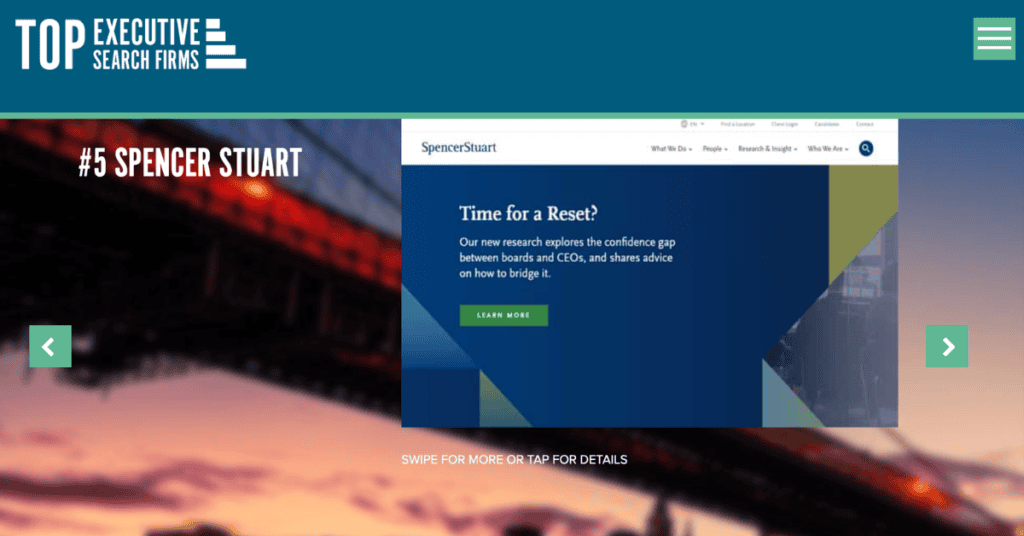
TopExecutiveSearchFirms.com
While analyzing the Google search results for the key phrase “top executive search firms”, the first search result was TopExecutiveSearchFirms.com. On the surface, the website appeared to offer a ranked list of the industry’s global giants. But as I dug deeper, the transparency that should accompany a professional ranking was entirely absent.
I identified four specific discrepancies that called the legitimacy of these rankings into question:
- Anonymous Ownership: The domain registration was private, and the website itself lacked contact information, a physical address, and a parent company name.
- The “Proprietary” Data Trap: The website purported to use a proprietary algorithm to rank firms based on data like “annual revenue” and “completion ratios.” In an industry as guarded as retained search, it was highly improbable that global firms would disclose this level of internal data to an anonymous entity.
- The Metadata Trail: A digital trail led to a marketing firm that listed this specific “microsite” as a project designed to help a single, lesser-known search firm client gain traction.
- Self-Appointed Rankings: That same lesser-known search firm that consistently ranked in the top five on the site it secretly owns—a ranking that has conveniently climbed higher over the years.
The TopExecutiveSearchFirms.com claims to rank the Top 20 Executive Search Firms “based upon a proprietary weighting of several criteria.” But the site does not disclose that it is owned by a search firm that awarded itself a #2 ranking. In other words, it is all a con. The ranking isn’t real. It is a marketing ploy to drive traffic to the search firm’s website.
How do we know that? A marketing firm listed the search firm as the client for one of its microsite projects. Below is a screenshot of the project.
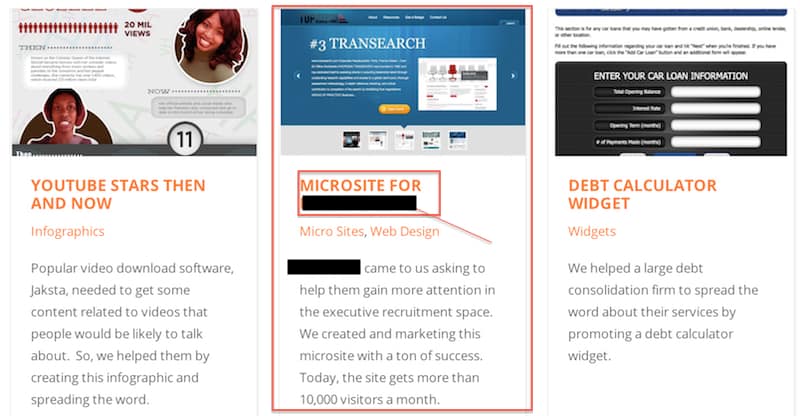
The Real Reason Behind the Fake Site
The marketing firm revealed the real reason for creating the website. The search firm:
“came to us asking to help them gain more attention in the executive recruitment space. We created and marketed this microsite with a ton of success. Today, the site gets more than 10,000 visitors a month.”
The marketing company displayed an image of TopExecutiveSearchFirms.com with a description of the work it did for a search firm—the name of which we have redacted.
The Search Firm Keeps Raising Its Bogis Ranking
Over the years, the search firm has given itself increasingly higher rankings on its concocted top search firm list. The microsite has moved the search firm higher every couple of years, from #5 in 2012 to #4 in 2014 to #2 today.
The Ripple Effect on Trusted Publications
Of course, the invention of a bogus rating website could be viewed as a pretty genius marketing move — if it weren’t for the pesky deceptive practices and its false, misleading statements. Then there’s the fallout. That same firm behind the fake website has found its way onto the top search firm lists of more trusted publishers like Forbes. The danger isn’t just one fake website peddling false information. In other words, misinformation generated by a single bogus site can spread to more established publications.

Forbes’ Best Executive Recruiting Firms
My investigation found that Forbes’ list of Best Executive Recruiting Firms includes the same questionable search firm whose primary claim to “top” status was its ranking on the fraudulent microsite that it owned. That search firm now ranks 19th on the Forbes list. Forbes explains that its Best list is based on surveys of more than 16,700 participants—recruiters, HR managers, hiring managers, and recent job candidates. Did misinformation from the bogus TopExecutiveSeachFirms website influence Forbes’ ranking, or was it the $6,000 the search firm appears to have paid Forbes for a premium profile? Whatever the answer, clearly, the entire ecosystem of “top lists” is unreliable.
The Search Firm CEO Did Not Comment
I contacted the CEO of the search firm responsible for the microsite by phone and email to request a comment. He did not respond. I am withholding the search firm’s name because I have no interest in picking a fight with a firm that has to make up its standing in the industry. Next, I contacted Forbes. They pointed to obtaining the search firm ranking information from Statistica.

CEOworld’s 100 Best Executive Search Firms
CEOworld has compiled a list of the top 100 Best Executive Search Firms and Consultants in America, 2025. Ranked #7 on the CEOworld’s 100 is the search firm that created the deceptive microsite. CEOworld does not disclose its methodology or information source.
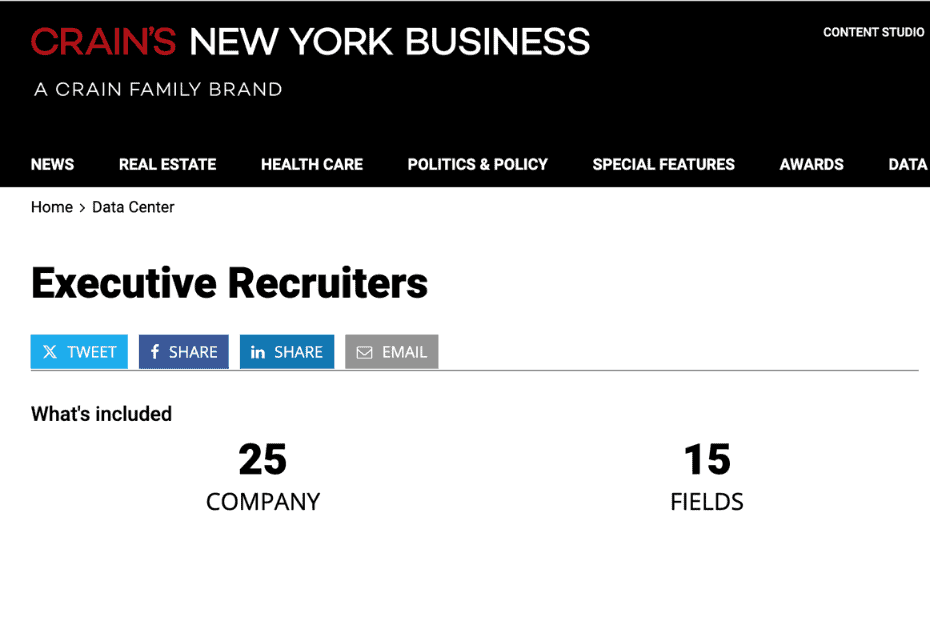
Crain’s 25 Largest Executive Recruiters
Crain’s New York Business has published a list of the 25 largest executive recruiters. It is available in Crain’s Book of Lists. Crain’s New York Business also sells the data for download.
However, if you are seeking a tidy list of top retained search firms, you will be disappointed. The list is a mashup of all kinds of firms that recruit talent, including staffing, temp, and contract recruitment firms. Additionally, search firm size informs — yet does not answer — whether the search firm is good.
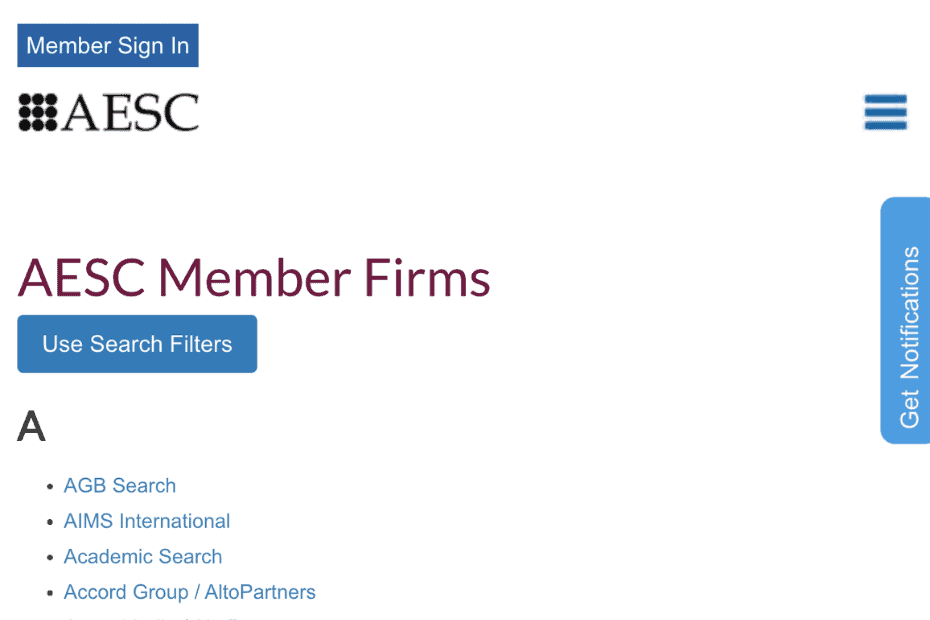
AESC Retained Search Firms List
The Association of Executive Search and Leadership Consultants offers a list of retained executive search firms. The AESC is the leading association of retained executive search firms. One benefit: its members do agree to abide by the AESC’s Code of Professional Conduct. In an industry where virtually anyone can hang out a shingle, that is not insignificant.
The List Features Only AESC Member Firms
However, the global list is limited to member firms. In addition, the list is not ranked: all member firms are created equal. In other words, if you are seeking a list of top executive search firms, this list is incomplete.
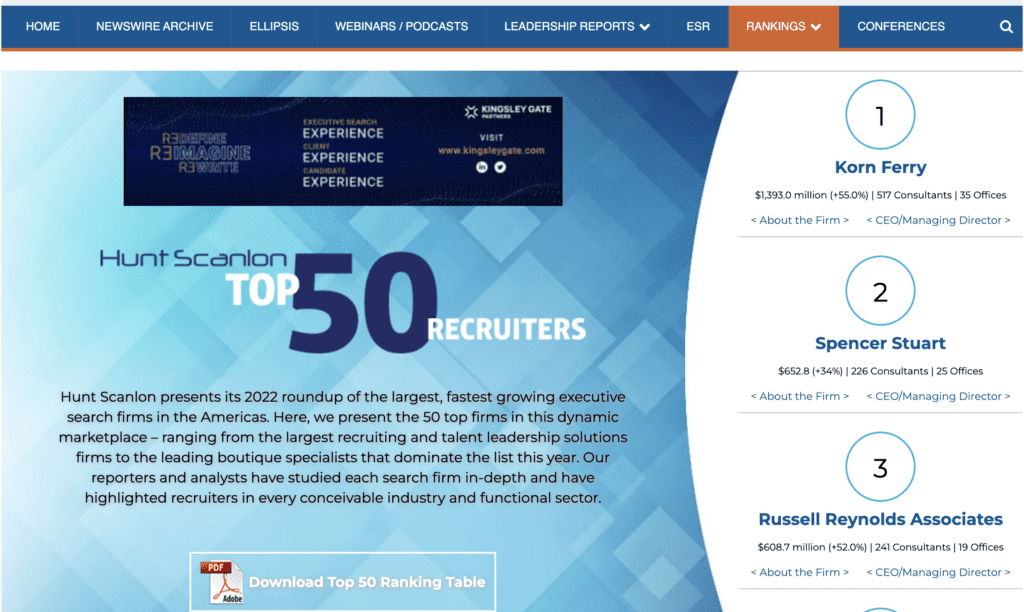
Hunt Scanlon Top 50 Recruiters
Hunt Scanlon is the publisher of Executive Search Review’s Top 50 Recruiters. To its credit, the search firm behind the deceptive TopExecutiveSearchFirms.com does not appear on the Hunt Scanlon list. The leadership intelligence company has covered the retained search industry for some 30 years and regularly produces detailed research reports. Its employees regularly communicate with CHROs, heads of talent acquisition, hiring executives, and the executive search consultants who serve them. As a result, they have their fingers on the pulse as industry experts.
The Hunt Scanlon List is the Most Reliable
Hunt Scanlon conducts original research to compile its list of the leading search firms. Hunt Scanlon Media — the most widely referenced, single source for information in the human capital sector. It specializes in covering the retained executive search business. While many of the search firms listed in the Top 50 also advertise with Hunt Scanlon, others do not. So out of all the lists, the Hunt Scanlon list seems the most reliable.
Building Your Own List is Ideal
Of course, if you have the time, compiling your own list of top executive search firms is ideal. You get to pick the firms. You can then verify the information to your own satisfaction. To learn more, visit Top Executive Search Firms: How to Build Your Own List.)
When AI Picks Your Headhunter
The fake ranking sites described above were designed to manipulate Google. A new and more consequential category of manipulation has emerged, and it targets something your board members and CHROs are now using for preliminary research: AI systems.
I tested four leading AI platforms — ChatGPT, Copilot, Gemini, and Perplexity — asking which executive search firms they recommend for AI leadership hiring. The results were consistent, confident, and in key cases, demonstrably wrong. The same firms that gamed Google have found their way into AI recommendations.
There Is Now a Commercial Product Built for This
There is a commercial product designed specifically to exploit AI recommendations. Meridian, an AI visibility optimization platform, claims it helped one retained search firm go from zero visibility to appearing in more than half of all AI recommendations for key executive search queries — in just eight weeks. Meridian CEO Alex Dees described the result in a February 2026 interview with Pulse2:
“Christian & Timbers, an elite executive search firm, went from zero visibility to a 60% mention rate for relevant recruiting queries in just eight weeks. They used Meridian to identify gaps in both their content strategy and their third-party citation presence, then systematically addressed weaknesses in their on-site positioning and off-site authority signals. The result was that AI assistants began recommending them alongside much larger, established competitors with genuine confidence.”
In plain language: Meridian identified the information sources that AI systems trust, and placed citations there. The firm’s actual executive search capability did not change. Its AI visibility did. It did so quickly because the executive search industry doesn’t generate much news and information compared to other industries. There was a dearth of information. In SEO, a dearth can be exploited.
Executive Search Is a Near-Perfect Data Void
That gap has a name in information science research: a data void. The deliberate act of filling that void with manufactured content — specifically to shape what AI systems learn and repeat — is called data void exploitation. Researchers at Harvard Kennedy School’s Shorenstein Center have documented how bad actors exploit data voids, creating content specifically designed to fill information gaps across enough indexed pages to become the dominant signal. The content doesn’t need to be true. It needs to be present, consistent, and structurally credible-looking.
Executive search is a near-perfect data void. Consider what doesn’t exist: no independent rating agency, no verified placement database, no audited methodology disclosure requirement, no regulatory body. The industry’s primary trade publications operate on subscription and advertiser models that create conflicts of interest. What does exist: self-published rankings, pay-to-play directory listings, press releases describing firms as “global leaders,” and a proliferation of ranking sites with no disclosed ownership and no accountability. Into this void, AI systems were trained. What they learned to recommend reflects the void they were trained on — not the underlying quality of the firms being recommended.
AI Systems Don’t Assess Credibility
This is the underlying vulnerability. Large language models don’t evaluate credibility. They recognize patterns and repetition. A claim stated consistently across dozens of indexed pages — regardless of who made the claim or whether any third party verified it — becomes a signal. Signal becomes training data. Training data becomes recommendation. The AI system that confidently recommends a search firm to your board is reporting what it learned, not what is true.
The Enforcement Gap
When Google was purely a ranking engine, manipulation was eventually penalized. Over fifteen years, Google built a significant enforcement architecture — named algorithm updates, spam policies, manual action penalties, and human quality raters. That architecture was designed to combat manipulation of search rankings. Google’s own spam policy explicitly targets content produced to manipulate ranking in search results.
But that policy was written for the old system. It does not address whether content designed to manipulate AI recommendations constitutes a violation. The rules for the new game have not been written. The manipulation operates in an enforcement vacuum.
How to Check AI Recommendations
Before acting on any AI recommendation for an executive search firm, apply these five prompts:
- Ask the AI to name its sources. Most systems will, if prompted. Check whether the sources cited are the firm’s own website, a pay-to-play directory, or an unattributed ranking site with no disclosed methodology. If the AI can only cite the firm’s own marketing materials, that’s your answer.
- Ask the AI why it excluded specific firms. The reasoning it produces will reveal whether it is working from a broad information base or a narrow, manufactured one.
- Ask the same question across multiple AI systems and compare results. If a firm appears on every AI-generated list but you have never encountered them in your industry, the consistency is the tell. It means the firm optimized for AI visibility, not for quality.
- Ask the AI directly: “Is this ranking based on independent evaluation or self-reported claims?” Current models will sometimes acknowledge the distinction when pressed.
- Ask the AI to distinguish between firms it recommends based on third-party coverage and firms it recommends based on the firm’s own content. That question alone will surface the manipulation in real time.
The Case for Data Integrity
The discovery that a primary industry ranking site is secretly owned by one of the firms it ranks is more than a marketing curiosity; it is a cautionary tale regarding data integrity in the executive search industry. When the line between independent reporting and corporate promotion is erased, the “best practices” of vetting search firms are fundamentally compromised.
For a Board or CEO, the lesson is clear: professional rankings are not a substitute for due diligence — and neither are AI recommendations. To ensure your search partner is selected on merit rather than marketing spend or AI visibility optimization, we recommend a four-step verification process:
- Audit Ownership: Before relying on a ranking, verify the organization behind the site. If the ownership is anonymous or linked to a marketing firm, the data should be considered compromised.
- Evaluate the Methodology: Authentic rankings rely on verifiable metrics or independent peer reviews. If a site claims access to private revenue data or “proprietary” completion rates without a clear audit trail, the results are likely speculative.
- Interrogate AI Recommendations: Apply the five-prompt verification process above before acting on any AI-generated list of search firms. What an AI system recommends reflects its training data, not an independent assessment.
- Prioritize Primary Research: The most reliable way to vet a firm remains direct evidence. Ask for client references, request specific case studies of recent placements in your sector, and build your own shortlist based on demonstrated investigative rigor.
Ultimately, the quality of a leadership hire depends on the quality of the information used to identify them. In a landscape where digital authority can be manufactured — and where AI recommendations can be purchased — the only reliable standard is the truth you verify for yourself.
1 Pulse2, “Meridian: Interview With Co-Founder & CEO Alex Dees About The AI Visibility Platform,” February 9, 2026. https://pulse2.com/meridian-profile-alex-dees-interview.
FAQs on Top Executive Search Firms Lists
No, not without verification. AI systems such as ChatGPT, Gemini, Copilot, and Perplexity recommend executive search firms based on patterns in their training data, not independent quality assessments. Commercial products now exist specifically to game AI recommendations by placing manufactured citations in the sources AI systems trust. The executive search industry is a near-perfect data void — with no independent rating agency, no verified placement database, and no regulatory oversight — making it particularly vulnerable to this manipulation. Always verify AI recommendations using primary research, client references, and the five-prompt interrogation method described on this page.
A data void is a gap in publicly available, credible information about a topic. Executive search is a near-perfect data void: there is no independent rating agency, no verified placement database, no audited methodology disclosure requirement, and no regulatory body. Researchers at Harvard Kennedy School’s Shorenstein Center have documented how bad actors exploit data voids by creating content specifically designed to fill information gaps across enough indexed pages to become the dominant signal in both search engines and AI training data. Because AI systems learn from what exists online, firms that manufacture credibility-signaling content in a data void can achieve AI recommendation visibility that bears no relationship to their actual quality.
Among published lists, Hunt Scanlon’s Top 50 Recruiters is the most reliable. Hunt Scanlon has covered the retained executive search industry for more than 30 years, conducts original research, and regularly communicates directly with CHROs, heads of talent acquisition, and search consultants. Unlike AI-generated lists or self-published rankings, Hunt Scanlon’s list does not include the firm responsible for the deceptive TopExecutiveSearchFirms.com ranking site. That said, the most reliable approach of all is to build your own list using primary research: direct client references, case studies of recent placements in your sector, and verified credentials.
Meridian is a commercial AI visibility optimization platform. Its CEO, Alex Dees, stated in a February 2026 interview that Meridian helped one retained executive search firm go from zero AI visibility to appearing in more than 60 percent of AI recommendations for key executive search queries in just eight weeks. Meridian achieves this by identifying the information sources that AI systems trust and systematically placing citations there — on-site content and off-site authority signals. The firm’s actual executive search capability does not change; only its AI visibility does. Meridian is an example of a broader category of commercial products designed specifically to exploit AI recommendation systems.
TopExecutiveSearchFirms.com is not a legitimate ranking. It is a fake ranking website secretly owned and operated by the same executive search firm that ranks itself #2 on the list. Investigation revealed that a marketing firm created the site as a promotional microsite for a single search firm client, with the explicit goal of generating traffic and visibility for that firm. The site claims to use a proprietary algorithm based on private industry data — data that retained search firms would never disclose to an anonymous third party. The owning firm has progressively elevated its own ranking from #5 in 2012 to #2 today. Despite this, the site has influenced rankings at more established publications including Forbes.
AI systems recommend based on patterns in their training data, not independent quality assessments. They do not evaluate credibility. A claim stated consistently across dozens of indexed pages — regardless of who made the claim or whether any third party verified it — becomes a signal. Signal becomes training data. Training data becomes recommendation. Because the executive search industry has no independent ratings infrastructure, the information environment AI systems were trained on reflects manufactured credibility signals, self-published rankings, and pay-to-play directory listings rather than verified performance data.
Apply five prompts before acting on any AI recommendation:
(1) Ask the AI to name its sources and check whether they are the firm’s own marketing materials or independent third-party coverage.
(2) Ask why the AI excluded specific firms to reveal how broad or narrow its information base is.
(3) Ask the same question across multiple AI systems — if a firm appears on every list but is unknown in your industry, the consistency signals AI visibility optimization, not quality.
(4) Ask the AI directly whether its recommendation is based on independent evaluation or self-reported claims.
(5) Ask the AI to distinguish between firms recommended based on third-party coverage versus the firm’s own content.
Do not rely on ranked lists, AI recommendations, or pay-to-play directories. Build your own shortlist using primary research: request client references from searches similar to yours in sector and seniority level, ask for case studies of recent placements, verify the firm’s actual placement history and completion rates, and ask specifically about their research methodology. The Hunt Scanlon Top 50 list is a reasonable starting point for identifying established firms. Audit ownership of any ranking site before trusting it. Apply the five-prompt AI verification method to any AI-generated recommendations before acting on them.
Got Search? Let’s Talk.
No executive search firm is right for every search every time. But we make it a practice to listen and to try to help, regardless.
The Hunt Scanlon list perfectly correlates with revenue. Is that the only filter? Bigger means better? And how would they know private firms revenue sources?
Hello Tom,
You make a good point. Privately held companies don’t have the reporting requirements of public companies. In addition, many private corporations, if asked, would refuse to share that closely held data. If you don’t, your firm is eliminated from the list.
“Best of” lists have always been a way for publications to drive revenue. The Fortune 500 is a case in point. However, when a publication accepts payments for advertising by companies that are honorees, it sets up a conflict of interest. Moreover, when honorees are desperate to be included on the list, they may provide misleading if not blatantly false information.
Take U.S. News & World Report’s “Best Medical Schools”. Havard Medical School has announced it is refusing to participate. Dean George Daley said, “As unintended consequences, rankings create perverse incentives for institutions to report misleading or inaccurate data, set policies to boost rankings rather than nobler objectives, or divert financial aid from students with financial need to high-scoring students with means in order to maximize ranking criteria. Ultimately, the suitability of any particular medical school for any given student is too complex, nuanced, and individualized to be served by a rigid ranked list, no matter the methodology.”
See https://hms.harvard.edu/news/hms-withdraws-us-news-world-report-rankings
I regularly receive offers to be featured in publications or have my company listed in a top list in exchange for payment — to date I have refused, knowing many of my competitors are fine with “checkbook journalism”. But having been a journalist in my former career, I find that practice antithetical to my beliefs.
It is only natural for a potential buyer of a thing or service to want a list — too many choices create a cognitive load that can be exhausting. Yet, clearly, one must take that list with a hefty grain of salt.