


Corporate executive search has reached a breaking point. Boards and CEOs are drowning in a sea of AI-generated applications while candidates, feeling the pressure of a stagnant market, apply to thousands of jobs at companies they rarely hear back from. Undergirding this chaos is a platform never designed for precision matching. To make executive search easier, you must first recognize that the tools you’ve been told to trust are designed to keep you inside a “walled garden,” not to help you find the right leader.
The Information Paradox: Too Much Data, Not Enough Intelligence
Ironically, while LinkedIn boasts over a billion members, the platform fundamentally lacks the high-fidelity data recruiters need to ferret out top-tier candidates. It is a social network that decided to monetize its graph by offering recruiting services, but it remains a system built on crowd-sourced, unreliable, and often abandoned profiles.
Because this data is incredibly variable and unstructured, it is easy for sourcers and recruiters to get lost in the noise. They find themselves looping through queries over and over again, uncertain whether they have truly identified all viable candidates at target companies or if they are simply seeing the same small pool of “optimized” profiles.
The Diagnosis: Platform Enshittification
This frustration isn’t a technical glitch; it is the result of a documented pattern of platform decay known as Enshittification. Coined by author Cory Doctorow, the term describes how platforms eventually prioritize their own bottom line at the expense of the users they serve.
In the case of executive search, this manifests as:
- Data Hide-and-Seek: LinkedIn intentionally obscures profile information, hiding experience behind “show more” buttons and upselling premium access to data that should be transparently discoverable.
- Filter Fatigue: The search filters are frustrating by design. Repeating the same search often returns different results, creating a “black box” that forces recruiters to spend more time—and more of your money—trying to find what’s right in front of them.
- Public Profiles Obscured: Within settings, LinkedIn previews what a Public profile displays to external viewers. LinkedIn’s demonstration of my external profile lists my extensive work experience and education. The only section in my profile that is obscured in my activity. However, when I am logged out of LinkedIn and view my profile in incognito mode, my Experience and Education are locked up tight.
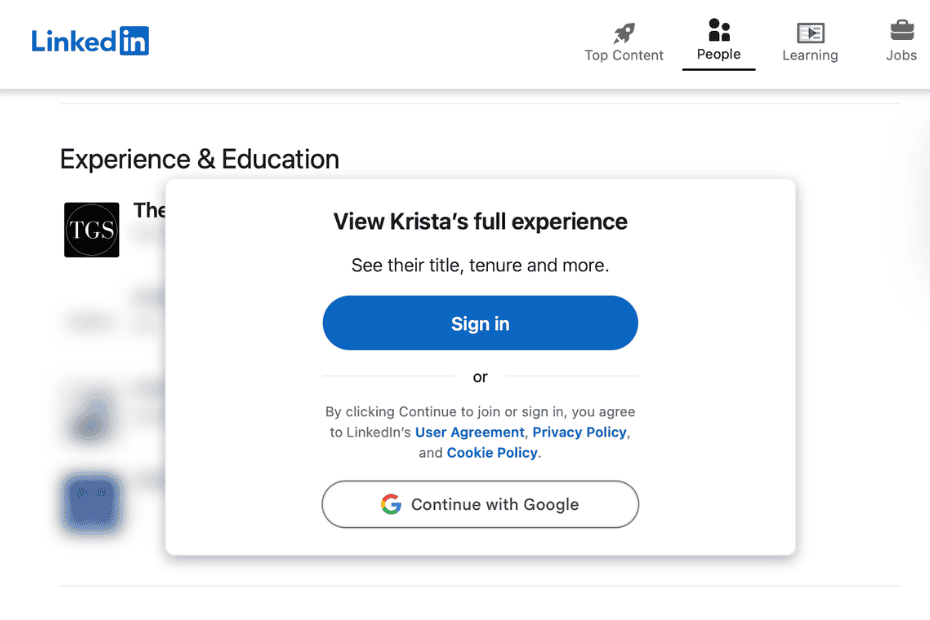
LinkedIn Fine Print
In my Public profile settings, LinkedIn’s fine print asserts, “You control your profile and can limit what may be shown in search tools and other off-LinkedIn services.” Search tools would be the filters within LinkedIn, off-LinkedIn Services include whether you want to share your profile with, say, Microsoft Outlook. .
However, LinkedIn’s fine print goes on to say that
“Viewers who aren’t signed in to LinkedIn may see all or some portions of the profile view displayed below.” Another notice says, “Preview only: This is a sample view to give you an idea of how your Activity section will look. The live version may appear differently.“
So, which is it, LinkedIn? Is my Public profile really public for anyone on the Internet to see without logging in? Or, as my example suggests, do you prevent the public almost all of the information contained in my profile. The answer is tucked away in LinkedIn Help, which explains, “Our public profile is a simplified version of your LinkedIn profile. Not all sections of your profile can be displayed publicly.”
It turns out LinkedIn has made it a practice to block access to purportedly Public profiles., The antitrust lawsuit, HiQ Labs, Inc. v. LinkedIn Corp, highlights legal battles over LinkedIn restricting access to public profiles. The Ninth Circuit Court of Appeals found that blocking access to truly public, non-password-protected profile data violated antitrust principles.
I take issue with LinkedIn making it harder for people seeking jobs to be discovered online by recruiters. As of February 2026, there are approximately 7.57 million unemployed workers in the US actively seeking jobs. While LinkedIn pads its bottomline by monetizing our profile data that belongs to us, more laidoff Americans who’ve never been unemployer are finding themselves in bread lines, struggling to feed their families.
Consider LinkedIn Detox
I’m not suggesting you give up LinkedIn entirely. But it is easy to become overly dependent on the social network. Its promises of making recruiting easier seem are so seductive With a billion members, your ideal candidate has to be in there, somewhere, ready to be found.
Consider the Motivations of Dating Apps
But consider this comparison to dating online. While there is no smoking gun, strong evidence and ongoing legal action suggests dating apps prioritize user retention over success. The business model relies on subscriptions and ad revenue, which thrive when users remain on the app, creating a structural conflict of interest between profit and finding a partner.
Consider the Motivations of LinkedIn
Since dating apps seem designed to keep members unhappily dating into perpetuity — it raises the question: might LinkedIn be up to similar tomfoolery? By making it harder to find candidates on LinkedIn, it can upsell recruiters and candidates into premium offerings, and by keeping us on LinkedIn longer — recruiters searchin for candidates, candidates searching for jobs — they can sell more advertising.
Aye, there’s the rub.
Powered by Intellerati: The Investigative Antidote
When you thnk about how hard LinkedIn, it could be a feature not a bug. So, the only way to make search easier is by taking a proactive, targeted approach to executive search. This is the secret sauce behind The Good Search. Our process is Powered by Intellerati, our dedicated executive search research lab and AI incubator.
We don’t rely on the “walled garden” of social networks. Instead, we harness the investigative methods of data journalism applied to recruiting to map industries, companies, and the best talent.
- Map Entire Industries: We build blueprints of organizations to identify the actual architects of success, regardless of their LinkedIn activity.
- Verify via Data Science: We extract and normalize disparate data from across the web to create evidence-based dossiers that go beyond self-reported resumes.
- Ensure Data Sovereignty: Through projects like Meritea, we are building a future where career data belongs to the worker, not a social network.
How to Make Search Not So Hard
The key to making executive search easier is to recognize that your primary tools may be working against you. When you move beyond the “billion-member” noise and embrace a data-driven methodology, the friction disappears. Search stops being a source of anxiety and starts being a wellspring of strategic growth.



These databases you mention… Any suggestions? I’m a young Executive Recruiter looking for more talent sources outside the usual resume databases and LinkedIn. Any suggestions would be greatly appreciated!
Ah, grasshopper, if I told you I’d have to shoot you;-) You need to ask yourself at the beginning of every engagement: where might data about our ideal candidate exist: If you are seeking license professionals, there are licensing boards with details about who is licensed, whether the license is current, and whether there have been disciplinary actions against them. There are governmental databases that are public. Every time we interact with a governmental agency, a record is created. With what federal, state, or local agency might your candidates interact? There are proprietary databases. Then also ask yourself whether there is a relevant industry database that might contain valuable data to help calibrate your candidates to determine who is a top performer. Last, often you need to “build your own” by appending data to a database of your own making. Data science resources and data journalism that uses data to find things out are good places to start to learn the basics. See the Data Journalism Handbook.